What keeps MT4 relevant after two decades
MetaQuotes stopped issuing new MT4 licences some time ago, steering brokers toward MT5. But most retail forex traders haven't moved. The reason is not complicated: MT4 works, and people trust what works. A huge library of custom indicators, Expert Advisors, and community scripts run on MT4. Switching to MT5 means rebuilding that entire library, and most traders don't see the point.
I spent time testing both platforms side by side, and the gap is marginal for most strategies. MT5 adds a few extras such as more timeframes and a built-in economic calendar, but the core charting is nearly identical. For most retail strategies, there's no compelling reason to switch.
Setting up MT4 without the usual headaches
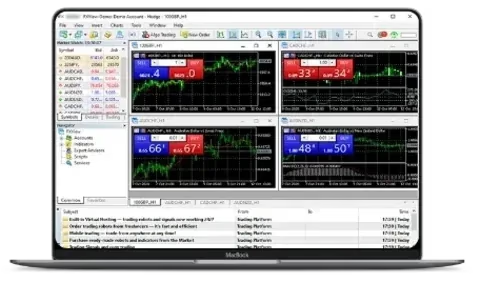
Downloading and installing MT4 is the easy part. What actually causes problems is the setup after install. On first launch, MT4 opens with four charts tiled across a single workspace. Clear the lot and start fresh with the markets you actually trade.
Chart templates save time. Set up your usual indicators on one chart, then save it as a template. Then you can load it onto other charts without redoing the work. Minor detail, but over weeks it makes a difference.
Something most people miss: open Tools > Options > Charts and check "Show ask line." The default view is the bid price on the chart, which can make entries appear wrong until you realise the ask price is hidden.
How reliable is MT4 backtesting?
MT4's built-in strategy tester allows you to run Expert Advisors against historical data. That said: the reliability of those results hinges on your tick data. Built-in history data is not real tick data, meaning it fills in missing ticks mathematically. If you're testing something that needs accuracy, download third-party tick data.
Modelling quality tells you more than the bottom-line PnL. If it's under 90% means the results shouldn't be taken seriously. People occasionally share screenshots with 25% modelling quality and can't figure out why the EA fails in real conditions.
Backtesting is where MT4 earns its reputation, but only if you feed it decent data.
Custom indicators on MT4: worth the effort?
MT4 comes with 30 standard technical indicators. Most traders never touch them all. That said, the platform's actual strength is in user-built indicators coded in MQL4. The MQL5 marketplace alone has over 2,000 options, covering everything from tweaked versions of standard tools to elaborate signal panels.
The install process is painless: copy the .ex4 or .mq4 file into your MQL4/Indicators folder, refresh MT4, and you'll find it in the Navigator panel. One thing to watch is reliability. Publicly shared indicators are hit-and-miss. Some are genuinely useful. Many are abandoned projects and may crash your terminal.
If you're downloading custom indicators, verify how recently it was maintained and if people in the forums report issues. A broken indicator doesn't only show wrong data — it can freeze MT4.
The MT4 risk controls you're probably not using
MT4 has several built-in risk management tools that most traders don't bother with. Probably the most practical one is the maximum deviation setting in the new order panel. This defines how much slippage is acceptable on market orders. Without this configured and you'll get whatever price comes through.
Stop losses are obvious, but trailing stops is worth exploring. Right-click an open trade, pick Trailing Stop, and enter your preferred distance. Your stop loss moves automatically as price moves into profit. Not perfect for every strategy, but if you're riding trends it takes away the temptation to sit and watch.
You can configure all of this in under five minutes and the difference in discipline is noticeable over time.
Expert Advisors — before you trust a robot with your money
EAs have obvious appeal: set rules, let the code trade, walk away. The reality is, a huge percentage of them lose money over any extended time period. The ones sold with flawless equity curves best metatrader 4 brokers tend to be curve-fitted — they performed well on historical data and stop working the moment market conditions change.
None of this means all EAs are worthless. A few people code personal EAs to handle well-defined entry rules: entering at a specific time, calculating lot sizes, or taking profit at predetermined levels. That kind of automation work because they do defined operations that don't require discretion.
When looking at Expert Advisors, run them on a demo account for no less than several weeks in different conditions. Live demo testing is more informative than backtesting alone.
MT4 beyond the desktop
MT4 is a Windows application at heart. Running it on Mac face a workaround. Previously was emulation, which mostly worked but came with display glitches and stability problems. Some brokers now offer macOS versions built on Crossover or similar wrappers, which are better but remain wrappers at the end of the day.
The mobile apps, on both iPhone and Android, are genuinely useful for keeping an eye on positions and tweaking stops. Full analysis on a 5-inch screen doesn't really work, but adjusting a stop loss on the go is worth having.
Check whether your broker offers a native Mac build or just a wrapper — the difference in stability is noticeable.